The Interpreter's Work Begins Before the First Sentence
Interpreter preparation for international meetings aligns terminology, documents, and turn-taking so delegates can follow the exchange without avoidable friction.
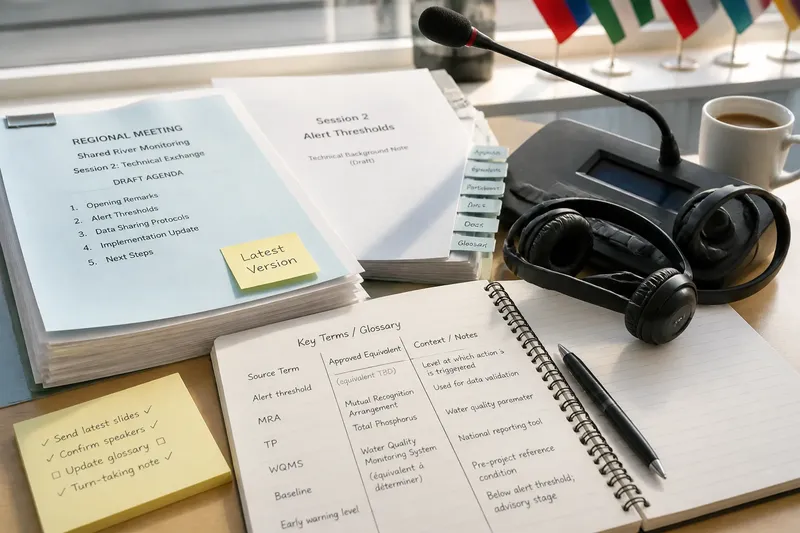
Interpreter preparation often starts while delegates are still deciding which folder to carry into the meeting room. A briefing paper arrives with an agency acronym, a draft agenda adds a technical session, and someone asks whether the interpreter has the latest version. These small details shape the spoken exchange before anyone takes the floor.
For organizers, the practical question is not simply whether an interpreter is booked. It is what kind of meeting is planned, what information can be shared, and how participants will take turns. The right preparation depends on the situation: a short bilateral conversation, a formal conference, and a working session with specialized language make different demands.
For a short bilateral meeting, prepare the people and the purpose
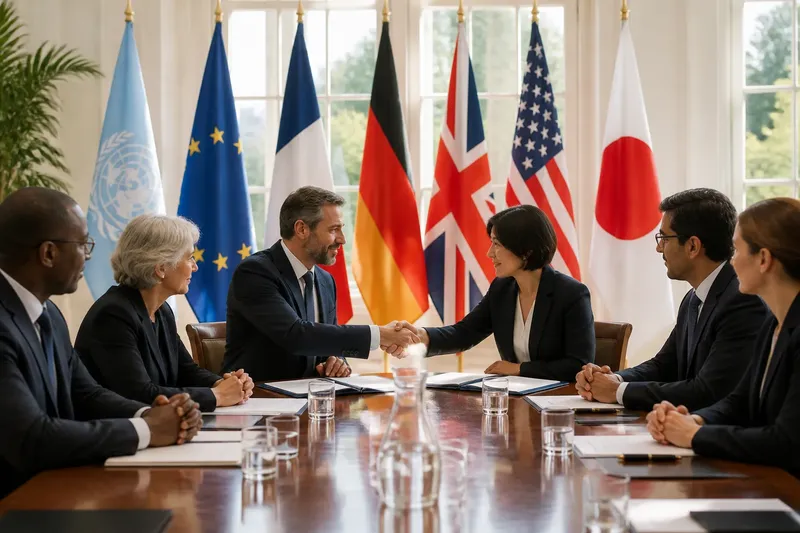
In a meeting between a small number of delegations, participants may speak directly to one another, with an interpreter rendering each turn. This format can support a conversation that feels personal, but it also leaves little room for improvising the mechanics. A speaker who talks for several minutes without pausing creates a long stretch of material to retain and interpret.
Before the meeting, provide the interpreter with the agenda, participant names and roles, the subject under discussion, and any documents expected to be mentioned. A short note on the meeting’s purpose is often more useful than a large folder of material with no indication of what matters. If sensitive topics are anticipated, organizers can describe them without disclosing information they are not authorized to share.
Names deserve attention. A list can include the preferred pronunciation of unfamiliar names, the titles participants use, and the official names of organizations. A place name may have different forms across languages; using the form preferred by a delegation can avoid a small but noticeable stumble at the opening.
For this situation, a concise briefing and clear turn-taking usually fit better than elaborate technical preparation. The meeting is short enough that the interpreter may not need a glossary, unless it includes specialized policy, legal, scientific, or financial terms. Agreeing that speakers will pause after a complete thought gives the interpreter room to work and gives participants a chance to hear the exchange accurately.
For a conference, prepare the materials that will be heard and seen
A conference often combines prepared remarks, slides, audience questions, and changes between speakers. The interpreter may need to work with a written speech, a presentation deck, or only a live delivery. Each format brings different language into the room. A slide can contain a shorthand term that a speaker expands in a different way, while a prepared statement may be read aloud faster than an interpreter can comfortably render it.
Send the current versions of speeches, slides, and session descriptions as early as practical, and identify which items are drafts. A file name such as “final” is not especially informative if three files carry it. A simple version date or a clear note that one document replaces another can prevent the interpreter from preparing for a phrase that has since been removed.
Do not assume that having a script means the interpreter can follow every word on the page. Speakers may depart from prepared text, add remarks, or respond to an earlier speaker. The interpreter still has to listen to what is said, not merely read ahead. A brief note identifying likely deviations or spontaneous segments can make the difference between useful preparation and a misplaced reading assignment.
For a large meeting, organizers should also confirm the interpretation format and the working languages with the interpreting provider. Simultaneous interpretation, in which interpretation proceeds as the speaker talks, differs from consecutive interpretation, in which the speaker pauses for the interpreted turn. The venue, equipment, schedule, and number of language combinations affect what can be arranged. This is a coordination decision, not a matter for the interpreter to settle alone in the corridor.
For a technical session, build a small working glossary
A technical session calls for more than a stack of background papers. It needs a manageable set of terms that are likely to recur and that may have established equivalents in the languages being used. This can include program names, institutional abbreviations, technical concepts, and terms whose everyday meanings differ from their meeting-specific meanings.
Ask the subject-matter team to supply preferred terms and brief explanations. Include the source language term, its approved equivalent where one exists, and a short context note. A glossary that says only “MRA — MRA” is not much help if participants use the abbreviation for different concepts. If there is no agreed equivalent, say so; the interpreter can then prepare a consistent way to explain the term rather than guessing at an official label.
Keep the glossary focused. A long list of every phrase that appears in a policy document can obscure the terms likely to be heard. Include acronyms that will be spoken aloud, names of working groups, recurring technical expressions, and terms that could be confused with a familiar word. Share changes when the agenda changes, rather than treating the first glossary as an artifact too precious to edit.
For example, imagine a regional meeting on shared river monitoring where the agenda uses the phrase “alert threshold” in several languages, but the technical team has not settled on a common equivalent. The organizer could send the relevant agenda paragraph and ask the team to clarify what condition the phrase refers to. The interpreter could then prepare a consistent rendering, while delegates would hear the same concept discussed under a stable term rather than an assortment of plausible guesses.
For a sensitive exchange, share enough context without oversharing
Some meetings involve confidential negotiations, personnel matters, or information that cannot be circulated widely. Preparation still matters, but the answer is not to send every document to every participant. Organizers can ask the interpreting provider what secure transfer and access arrangements are available, then share only the material needed for the assignment.
Where a document cannot be shared, a short oral or written briefing may still identify the meeting’s subject, the participants, the relevant terminology, and any procedural expectations. That context does not need to disclose the substance of a confidential position. It helps the interpreter recognize the subject matter and prepare for the vocabulary without turning the briefing into a second negotiation.
Clarify who is authorized to provide documents and who should receive them. Avoid sending sensitive files through an informal channel simply because it is convenient. For legal, security, or confidentiality questions, use the organization’s applicable procedures and qualified advice; the interpreter should not be asked to make institutional rules on the spot.
For a remote meeting, prepare the channel as well as the language
Remote interpretation adds a technical path between speaker and listener. Participants may join from different locations, use headsets of uneven quality, or speak over one another because a brief delay makes a pause feel longer than it is. An interpreter cannot render speech that arrives broken, masked by background noise, or lost when someone changes audio devices.
Organizers should confirm the platform’s interpretation functions, the language channels, and how participants will select them. Ask speakers to use a stable microphone and a quiet setting, and arrange a short technical check with the interpreting team before the session. A sound check is not a rehearsal of the meeting; it is a chance to catch a muted microphone or an unavailable channel before the room fills.
Remote participants also need a simple explanation of how to request the floor and how to signal that they are finished. A chair can repeat the speaker’s name before recognizing a question, and can pause between turns rather than selecting the next speaker while the previous one is still audible. The platform may offer buttons, but buttons do not establish conversational order by themselves.
How much preparation does this meeting need?
Should organizers send the full agenda and all background papers?
Send the agenda and the material likely to be cited, then identify what is current and what is background. A well-marked selection is more useful than an unfiltered archive, especially when the meeting’s focus is narrow.
What if a speaker changes the prepared remarks?
The interpreter follows the spoken remarks, not an outdated script. Organizers can reduce confusion by alerting the interpreter to planned changes and asking speakers to provide revised material when practical.
Should delegates receive the glossary?
That depends on the meeting’s purpose and the status of the terms. Sharing an approved glossary can help delegates use consistent language, but draft or disputed terminology should be clearly marked rather than presented as settled.
What should the chair do if a speaker talks for too long?
The chair can ask speakers to pause at natural intervals and remind them to use the microphone. This is a meeting-management measure, not a request to simplify the substance of what they say.
Choose preparation that matches the meeting, not the paperwork
A useful preparation package reflects the work the interpreter will actually do. For a short bilateral meeting, that may mean names, roles, purpose, and a few terms. For a conference, it may include current speeches and slides. For a technical session, a focused glossary matters; for a sensitive exchange, secure and limited sharing matters; for a remote meeting, audio and turn-taking need attention.
Not every detail deserves a briefing note. Elaborate biographies, every past communiqué, and long lists of hypothetical vocabulary can consume attention without helping the next conversation. The more useful question is whether a piece of information changes how a term is understood, who is speaking, or how the meeting will proceed.
Interpreter preparation is therefore part of meeting design. Organizers who decide what to share, how to manage turns, and which terms need clarification make spoken exchange more workable for everyone in the room. The interpreter’s work begins before the first sentence; the chair’s work is to leave enough space for the next one.